Three performance models
Free, metronome-based, and sequence-based looping can be chosen song by song without rebuilding the complete rig.
Rig Walkthrough
Mike Criscione demonstrates a Loopy Pro rig that moves between free, metronome-based, and sequence-based looping for solo shows and full-band performances.
Quick Glance
A colour-coded performance system for guitar, bass, keys, vocals, hosted instruments, MIDI control, sequenced arrangements, and weather-ready outdoor shows.
Free loops for spontaneous playing, metronome-based loops for a click-synchronised band, and sequence-based loops for automated arrangements.
iPad Air 5, Behringer XR18, powered USB hub, FCB1010 foot controller, Axiom 49 keyboard, compact Akai controller, and a second mixer-control iPad.
Colour-coded routing, hosted instruments and effects, fewer on-stage button presses, plus separate protection from direct sun, heat, and rain.
From the Musician
Originally published by Mike Criscione on YouTube, this walkthrough offers a detailed look at a real Loopy Pro setup.
Mike Criscione has spent roughly twenty-five years working with loopers. His Loopy Pro rig now sits at the centre of both his solo performances and shows with his cover band, Ultraviolet, but the walkthrough begins with a useful reminder: live looping is not one fixed method.
Mike divides it into three approaches. Free looping follows the familiar pedal model, with the performer defining the start and end of each loop by foot. Metronome-based looping places every recording and transition against a shared tempo. Sequence-based looping adds a timeline where recording, playback, mixing, and other actions can be arranged before the performance begins.
Loopy Pro handles all three inside the same rig. That range is the thread running through Mike’s demonstration, from an open-ended solo song to a click-synchronised band arrangement and a more extensively programmed original.
“It’s sort of become the heart and soul of my setup.”
The main canvas uses colour to make a busy setup readable. Orange represents acoustic guitar, green electric guitar, blue bass or subharmonic synth, purple keyboards and synths, red drums, and yellow vocals. Each family can be recorded, processed, mixed, and brought in or out independently.
That visual organisation is especially helpful when a song moves between sections. Mike can see what belongs to each musical role without reading small labels or tracing a conventional mixer. The workspace communicates the arrangement while the physical controllers handle the actions that need to happen under his hands and feet.
Mike’s first example works like a conventional hardware looper. He records a guitar progression with a foot press, closes the loop on the next pass, adds a subharmonic bass line, and overdubs another guitar part. The tempo and loop length are created by the performance rather than decided in advance.
It is an important part of the walkthrough because large custom workspaces can make Loopy Pro look inherently complicated. Mike shows that the same system can still behave like a straightforward pedal looper when that is what the music needs.
For Ultraviolet’s version of Lizzo’s Juice, the structure changes. The session has a predefined tempo, the band receives a click, and the loop lengths follow the metronome. Mike can cue the next section during the current cycle; Loopy Pro waits for the correct boundary before bringing it in.
That removes the fragile hand-off between a freely timed loop and a live drummer. The loop, chorus, post-chorus, and added layers arrive on the downbeat even when Mike presses the control early. The performance remains responsive without requiring a perfectly timed pedal press for every transition.
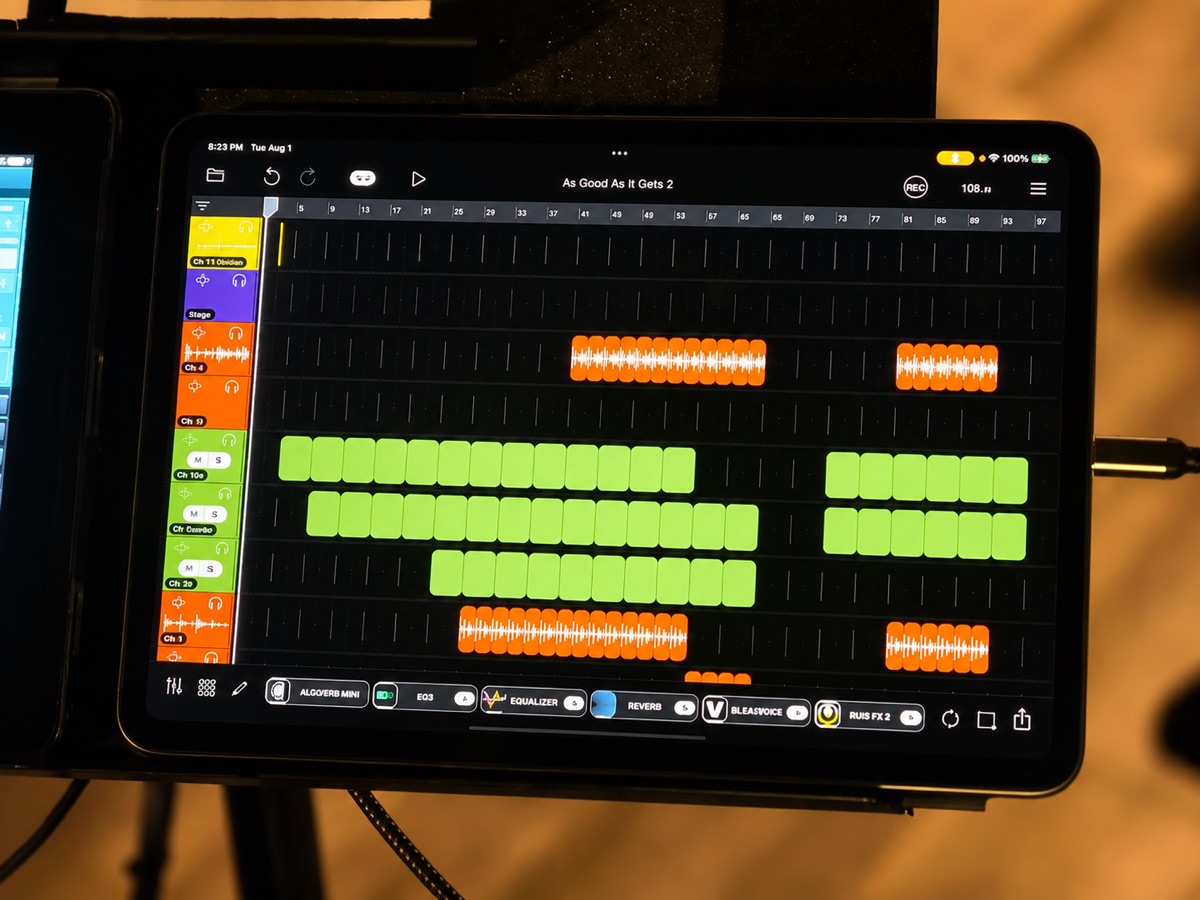
Mike’s original song As Good As It Gets demonstrates the third model. Some material is prepared, while guitar and subharmonic bass loops are recorded live. A sequence timeline determines where those recordings recur and when different elements enter or leave.
He also uses silent “dummy loops” containing follow actions. They can mute a source, adjust a level, switch an effect, or trigger another Loopy Pro function without adding audio. Once a live phrase is captured, it populates the places already defined for it on the timeline.
The automation is there to protect the musical part of the show. Mike can sing and play through the arrangement without turning every transition into a choreography of pedal presses.
“The more complicated a setup you get, the more the button presses take you out of the song and take you out of the performance.”
Loopy Pro also hosts the sound sources and processing behind the canvas. Bias FX handles guitar sounds and responds to MIDI preset changes. AudioLayer provides sampled instruments, Ravenscroft 275 supplies piano, Galileo adds a drawbar organ controlled from the keyboard, and B Voices creates keyboard-directed vocal harmonies.
The external gear is therefore mostly control and I/O. An iPad Air 5 runs Loopy Pro, while an older iPad controls the Behringer XR18 mixer. A powered USB hub keeps the iPads, XR18, and controllers connected and charged. On the floor, a Behringer FCB1010 provides ten switches and two expression pedals. An Axiom 49 keyboard controls instruments and organ drawbars, while a small Akai controller recalls guitar presets.
The final part of Mike’s walkthrough addresses a less glamorous part of professional iPad performance: weather. An iPad merely controlling a mixer is replaceable during a show; an iPad processing every instrument and running the loops is mission-critical.
For outdoor work, he places the iPads on a USB cooling pad and uses a collapsible photographic monitor shade to block direct sunlight. The distinction between ambient heat and solar radiation matters because a tent may stop rain without stopping low-angle sun. He has used the shaded, fan-cooled setup through three-hour outdoor gigs while the iPad remained charged.
Rain is treated separately. Clear plastic bags can cover a pedalboard, stand, or complete control surface quickly and protect equipment from water above and a wet stage below. It is practical advice born from years of regular outdoor shows, and a good example of reliability being designed around the whole environment rather than the app alone.
“Heat protection and water protection are really two independent things.”
One colour-coded workspace supports spontaneous solo looping, click-synchronised band arrangements, and sequence-driven original music.
Free, metronome-based, and sequence-based looping can be chosen song by song without rebuilding the complete rig.
An iPad Air 5 runs Loopy Pro, a Behringer XR18 handles audio I/O, and a powered hub connects and charges the wider system.
An FCB1010, Axiom 49, compact Akai controller, and older mixer-control iPad divide performance tasks across familiar hardware.
Active cooling, direct-sun shading, dependable power, and separate rain protection keep the mission-critical iPad operating.